

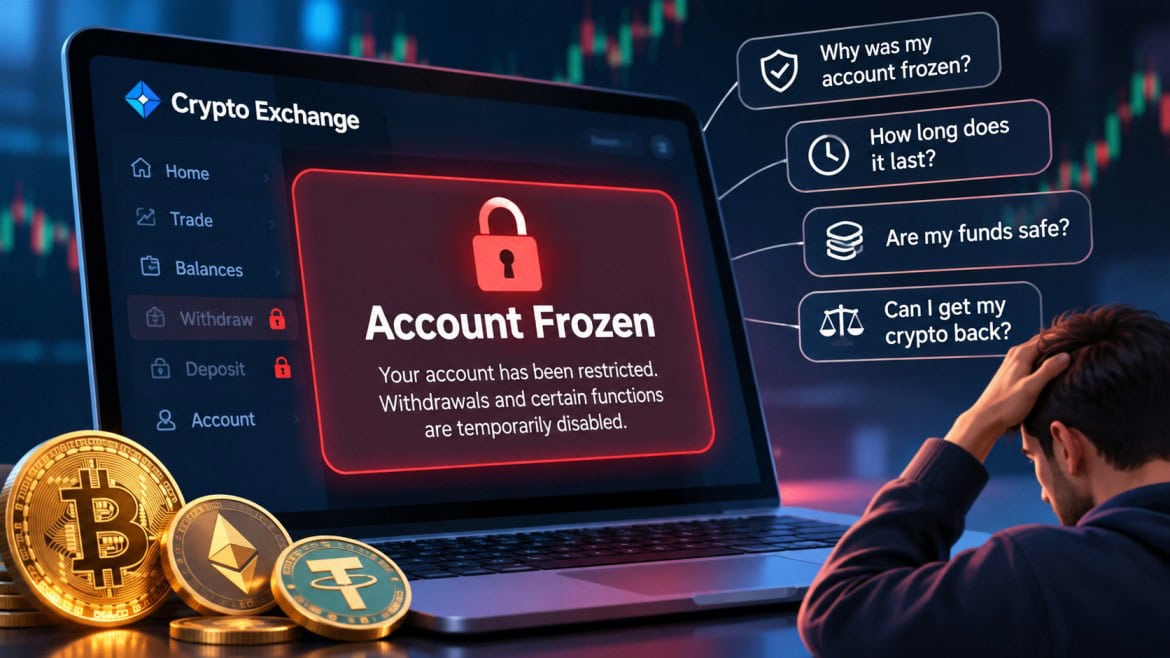
Imagine logging into your cryptocurrency exchange and discovering that your account has been restricted. Your balance is still visible, but you cannot withdraw Bitcoin, transfer USDT, or access certain trading features. Customer support tells you that your account is under review, but provides little information about when the restriction will be lifted.
For cryptocurrency users, this situation can be particularly stressful because digital assets are often expected to be accessible around the clock. However, cryptocurrency exchanges can restrict accounts or individual transactions for security, identity verification, regulatory compliance, and legal reasons.
A frozen crypto account does not necessarily mean that your funds have been stolen or permanently lost. In many cases, restrictions are temporary and may be removed after the exchange completes its investigation. In other situations, legal or regulatory requirements can prevent an exchange from releasing certain assets.
Understanding why exchanges freeze accounts, what happens to the funds, and how to respond can help users avoid mistakes that make the situation worse.
What Does It Mean When a Crypto Exchange Freezes Your Account?
A frozen cryptocurrency account generally means that an exchange has restricted access to some or all account functions.
However, the term “frozen” can describe several different situations. An exchange might disable withdrawals while allowing users to trade, restrict deposits while reviewing a transaction, or suspend the entire account.
The restrictions depend on the reason for the review and the exchange’s internal policies.
Common examples include:
- Withdrawal restriction: Users can access their accounts but cannot transfer cryptocurrency to external wallets.
- Trading restriction: Buying, selling, or converting digital assets is temporarily disabled.
- Deposit restriction: Incoming cryptocurrency or fiat deposits are not accepted or credited.
- Account suspension: Users may be unable to access most account functions.
- Transaction hold: A particular deposit or withdrawal is delayed while the exchange checks its source or destination.
- Legal asset freeze: Certain funds cannot be transferred or withdrawn because of a legal or sanctions-related requirement.
These situations should not be treated as identical. For example, a delayed USDT withdrawal does not necessarily mean that the user’s entire exchange account has been frozen.
The first step is to identify exactly which account functions are restricted.
Why Do Cryptocurrency Exchanges Freeze User Accounts?
Cryptocurrency exchanges operate under security, financial crime prevention, and regulatory requirements that vary by jurisdiction. Their monitoring systems can identify activity that requires additional verification or investigation.
Here are some of the most common reasons.
1. Suspicious Transactions and Unusual Account Activity
Exchanges monitor deposits, withdrawals, login attempts, and trading activity to identify patterns that could indicate fraud or unauthorized access.
For example, an account that normally withdraws small amounts of USDT might suddenly attempt to transfer a much larger balance to a newly added wallet.
Other activities that could trigger additional checks include:
- Multiple withdrawals to unfamiliar wallet addresses.
- Sudden changes in transaction size or frequency.
- Unusual login locations or devices.
- Repeated failed authentication attempts.
- Transfers involving wallets associated with reported scams or suspicious activity.
These signals do not automatically prove wrongdoing. They may simply cause the exchange to request additional information before processing a transaction.
2. Incomplete KYC or Identity Verification
Know Your Customer (KYC) procedures require exchanges to collect and verify information about their customers.
An account may face restrictions when identity documents expire, personal information becomes inconsistent, or the exchange cannot verify the submitted details.
Users may be asked to provide:
- A valid passport, national identity card, or other accepted identification.
- Proof of residential address.
- A selfie or facial verification.
- Updated personal information.
- Additional documents explaining account ownership.
Binance states that incomplete identity verification can lead to temporary withdrawal suspensions. Its guidance also identifies missing facial verification and certain account security requirements as possible reasons for withdrawal limitations.
Completing KYC does not guarantee that every restriction will immediately disappear, particularly if the account is also subject to a separate compliance review.
3. Anti-Money Laundering (AML) Investigations
Anti-Money Laundering requirements are another major reason exchanges may restrict transactions.
Cryptocurrency exchanges can be required to investigate transactions that appear inconsistent with a customer’s expected activity or may involve funds connected to financial crime.
For example, an exchange might request additional information when a user receives cryptocurrency from a wallet associated with a reported scam or sends funds through several unrelated platforms.
The Financial Action Task Force (FATF) recommends that virtual asset service providers implement customer due diligence, maintain transaction records, and report suspicious transactions in accordance with applicable requirements.
These obligations can result in additional checks on both incoming and outgoing transfers.
4. Transfers Linked to High-Risk Wallet Addresses
Blockchain transactions are publicly recorded, which allows compliance companies and exchanges to analyze the history of cryptocurrency addresses.
Some wallet addresses may be associated with:
- Reported cryptocurrency scams.
- Ransomware payments.
- Stolen digital assets.
- Sanctioned individuals or entities.
- Certain illicit marketplaces.
- Fraudulent investment schemes.
If an exchange identifies a potential connection between a customer’s transaction and a high-risk address, it may delay or restrict the transfer while investigating.
Importantly, interacting with an address flagged by a monitoring system does not necessarily establish that the account holder participated in criminal activity. Blockchain analytics can identify transaction relationships, but the surrounding circumstances still matter.
5. Sanctions and Regulatory Restrictions: The MEXC Case
Cryptocurrency exchanges operating in regulated markets must comply with applicable sanctions, anti-money laundering requirements, and financial restrictions. When regulators identify potential violations, exchanges and financial institutions may be required to block certain transactions or restrict access to specific funds.
A recent example involves MEXC Global, which faced a major regulatory action from the US Treasury’s Financial Crimes Enforcement Network (FinCEN) on November 6, 2026.
Under the order announced through Operation Economic Outcast, FinCEN prohibited covered US financial institutions from processing funds transfers involving MEXC. The US Treasury alleged that approximately $16.7 billion in transactions connected to illicit financial activities passed through the exchange between May 2021 and May 2026.
Although the measure did not constitute a worldwide shutdown of MEXC or an automatic freeze of every customer account, it created additional compliance concerns for users transferring cryptocurrency between exchanges.
The consequences became visible when receiving platforms began tightening their controls on MEXC-related transactions. KuCoin announced that incoming deposits from MEXC Global and specified affiliated entities could be temporarily withheld for compliance reviews, while certain outgoing transfers to those entities would be declined.
In a separate reported case, multiple transfers from MEXC to KuCoin and Redot were deducted from the sender’s MEXC balance but did not appear in the receiving accounts. Customer support reportedly indicated that the investigation could take up to 30 days.
You can read the full report here: MEXC Ban: Users Report Frozen Transfers to KuCoin and Redot.
The situation demonstrates how regulatory actions involving one exchange can affect customers even when they attempt to move their own cryptocurrency to another platform.
It is also important to distinguish regulatory restrictions from ordinary account reviews. For example, the US Treasury’s Office of Foreign Assets Control (OFAC) explains that blocking property prohibits transfers or other dealings involving blocked assets. Such property is generally not considered permanently seized, but its release may require regulatory authorization.
For users, the key lesson is that a completed withdrawal does not always guarantee immediate access to funds on another exchange. Before transferring significant amounts, customers should confirm whether the receiving platform accepts deposits from the originating exchange and whether additional compliance checks apply.
6. P2P Trading Disputes and Payment Reversals
Peer-to-peer (P2P) trading can also lead to account restrictions.
A transaction may become subject to investigation if a buyer reports a payment problem, a bank transfer is reversed, or the exchange receives a fraud complaint.
For example, a seller might receive a bank transfer from someone whose account was later reported as compromised. Even if the seller believes the transaction was legitimate, the exchange or payment provider may investigate the source of the funds.
Users should retain payment receipts, order details, chat records, and transaction references when using P2P services.
7. Multiple Accounts or Terms of Service Violations
Exchanges also enforce their own user agreements.
Restrictions may be applied when an account is associated with prohibited activity, unauthorized account sharing, misleading identity information, market manipulation, or other violations of platform rules.
The consequences depend on the exchange’s terms and the circumstances of the case. Some restrictions can be appealed, while others may result in account closure.
What Happens to Your Crypto When an Exchange Freezes Your Account?
One of the biggest concerns for users is whether their cryptocurrency is still safe.
The answer depends on the type of restriction.
In many cases, the exchange continues to display the user’s balance while limiting withdrawals or other account functions. However, a visible balance does not necessarily mean the funds can currently be accessed.
There are several possible outcomes:
Temporary withdrawal restriction: The exchange holds withdrawals while completing a security or compliance review. Trading or other services may remain available.
Transaction under investigation: A particular deposit or withdrawal is delayed while the exchange verifies its source, destination, or supporting information.
Account closure: The exchange may terminate its relationship with a customer. Depending on the circumstances, it may provide a process for withdrawing eligible remaining balances.
Legal freeze: Assets may be blocked because of a court order, sanctions requirement, or another applicable legal restriction. The exchange may not be permitted to release the funds without authorization.
Coinbase, for example, explains that account restrictions can affect different services independently. In some account-closure situations, eligible remaining cryptocurrency can still be transferred to an external wallet, while certain legally blocked funds cannot be withdrawn.
Therefore, users should never assume that every account freeze means the exchange has permanently taken their assets.
What Should You Do If a Crypto Exchange Freezes Your Account?
If your account suddenly becomes restricted, responding carefully is important. Repeated withdrawal attempts, opening multiple support tickets, or submitting inconsistent information can make an investigation more complicated.
The following steps can help you handle the situation.
Step 1: Identify the Exact Restriction
Log in through the exchange’s official website or application and check the account notifications.
Determine whether the restriction affects:
- Cryptocurrency withdrawals.
- Fiat withdrawals.
- Deposits.
- Trading.
- The entire account.
Look for a specific explanation, reference number, or request for additional verification.
If the exchange has only restricted one withdrawal, do not assume that all your account assets are frozen.
Step 2: Contact Official Customer Support
Open a support ticket through the exchange’s official website or application.
Ask the support team to clarify:
- Which account functions are currently restricted?
- Is the restriction related to identity verification, account security, transaction monitoring, or a legal requirement?
- Are additional documents required?
- Is there a case or investigation reference number?
- Is there an estimated review period or a way to request an update?
Some exchanges cannot disclose every detail of a compliance investigation. However, requesting clear information about the next required action can help move the process forward.
Step 3: Prepare Documents Explaining the Source of Funds
If the exchange requests additional information, provide complete and consistent documentation.
Depending on the transaction, useful records may include:
- Bank statements.
- Proof of income or business revenue.
- Cryptocurrency purchase receipts.
- Exchange deposit and withdrawal records.
- Blockchain transaction IDs (TxIDs).
- P2P order histories and payment confirmations.
- Invoices or contracts explaining the purpose of a transfer.
- Documents showing ownership of the sending or receiving wallet.
For example, if you received 5,000 USDT from another exchange, the receiving platform may ask you to explain where the funds originated.
You may need to provide the withdrawal confirmation from the sending exchange, the transaction hash, and relevant records demonstrating the source of the funds.
Only submit sensitive documents through the exchange’s verified support or compliance channels.
Step 4: Keep a Record of Every Communication
Save copies of support tickets, emails, verification requests, and transaction confirmations.
Record the dates when you contacted the exchange and the responses you received.
If the case continues for several weeks, having a clear timeline makes it easier to escalate the issue or seek professional advice.
Step 5: Request a Formal Review or Appeal
If the exchange does not resolve the restriction after you have submitted the requested documents, ask whether a formal review or appeal process is available.
Some platforms provide dedicated procedures for identity-verification failures, withdrawal restrictions, or account suspensions.
For example, Binance provides withdrawal and identity-verification appeal processes for certain restrictions. However, Binance also states that not all restrictions are eligible for appeal, particularly when legal or regulatory obligations are involved.
Step 6: Consider Regulatory or Legal Assistance
If a substantial balance remains inaccessible and the exchange does not provide a clear resolution, consider seeking advice from a qualified lawyer familiar with cryptocurrency and financial services regulation in the relevant jurisdiction.
Depending on where the exchange operates and where the customer resides, it may also be possible to submit a complaint to the relevant financial regulator or consumer protection authority.
The correct authority and complaint process depend on the legal entity operating the exchange and the user’s jurisdiction.
If the restriction involves a court order or sanctions requirement, professional legal advice may be particularly important.
How Long Does a Crypto Exchange Account Freeze Last?
There is no universal timeframe for resolving a frozen cryptocurrency account.
The duration depends on the reason for the restriction, the documents required, the complexity of the investigation, and the exchange’s internal procedures.
Official exchange guidance illustrates how different these timelines can be:
Also Read: Top 5 Crypto Exchanges in 2026: Best Trading Platforms
| Exchange | Published guidance |
|---|---|
| Coinbase | Account restriction resolution and response reviews typically take up to 10 business days; some cases take longer |
| Kraken | Temporary account restrictions are usually reviewed within 10–14 business days |
| Binance | Certain account-unlock processes may require additional review; some successful unlocks require up to 48 hours before withdrawals resume |
| OKX | Review and restriction procedures vary depending on the reason and required action |
These are platform-specific estimates, not guarantees. They should not be interpreted as deadlines that apply to every frozen account.
A straightforward identity-verification issue may be resolved relatively quickly, while an investigation involving suspicious transactions, sanctions exposure, or law enforcement can take considerably longer.
Users should follow the specific instructions provided by their exchange rather than relying on general estimates found online.
Can a Crypto Exchange Freeze Your Account Without Warning?
In some situations, yes.
Exchanges may apply automatic restrictions when their security systems identify unusual activity or a potentially risky transaction.
For example, an exchange may temporarily block a withdrawal after detecting an unfamiliar device, an unusual login location, or a transaction that requires additional verification.
In other cases, an exchange may notify the customer after the restriction has already been applied.
Legal and sanctions-related restrictions can also limit what an exchange is allowed to disclose. Certain financial crime investigations are subject to confidentiality requirements.
However, the exact notification and explanation obligations depend on the applicable laws, regulations, and platform terms.
Users should check their registered email address, in-app notifications, and official support channels regularly.
Can You Withdraw Your Money If Your Exchange Account Is Frozen?
It depends on which functions have been restricted.
Some exchanges allow customers to access their accounts and withdraw certain assets even when trading is disabled. Others temporarily suspend all withdrawals while completing an investigation.
For example, Coinbase explains that some customers with restricted accounts may still be able to convert cryptocurrency into cash and withdraw eligible funds to a verified bank account during a review.
However, Coinbase also makes clear that certain security and risk factors can affect withdrawal availability.
If assets are subject to a legal freeze, users generally cannot bypass the restriction by requesting another withdrawal method.
It is important to ask the exchange whether the restriction applies to the entire balance or only specific assets and transactions.
Can You Prevent Your Crypto Exchange Account From Being Frozen?
No user can guarantee that an exchange will never restrict an account. However, good account and transaction practices can reduce avoidable problems.
Here are several precautions worth following:
Complete identity verification: Keep your personal information and identification documents up to date.
Use accounts in your own name: Avoid using another person’s identity, bank account, or exchange account to conduct transactions.
Keep transaction records: Save blockchain transaction IDs, exchange confirmations, invoices, and P2P payment receipts.
Use consistent funding methods: Transfers between accounts with matching ownership information may be easier to document when an exchange requests verification.
Avoid suspicious counterparties: Be cautious when receiving cryptocurrency from unknown individuals or wallets associated with reported scams.
Enable strong account security: Use two-factor authentication, passkeys where available, and unique passwords.
Understand exchange restrictions: Review the platform’s terms, supported countries, withdrawal requirements, and policies before transferring significant amounts.
Respond to verification requests: Do not ignore official requests for updated documents or transaction information.
These measures do not prevent every compliance review, but they can make it easier to demonstrate ownership and explain legitimate transactions.
Is It Safer to Keep Cryptocurrency on an Exchange or in a Personal Wallet?
The possibility of account restrictions raises an important question: should cryptocurrency users keep their assets on centralized exchanges?
Centralized exchanges provide convenience. They allow users to trade, convert assets, access fiat payment services, and manage multiple cryptocurrencies through one account.
However, users depend on the exchange’s account policies, security systems, operational status, and regulatory obligations.
With a self-custody wallet, users control their private keys and can generally authorize transactions without relying on a centralized exchange to approve each transfer.
Nevertheless, self-custody introduces different risks. Losing a recovery phrase, signing a malicious transaction, downloading a fake wallet application, or sending funds to an incorrect address can result in permanent losses.
Neither option is completely risk-free.
A practical approach is to keep only the funds needed for regular trading or payments on an exchange and consider self-custody for longer-term holdings, provided the user understands how to secure a wallet properly.
Frequently Asked Questions
Does a frozen crypto exchange account mean my money is gone?
No. An account restriction does not automatically mean that cryptocurrency has been stolen or permanently lost. The exchange may simply have disabled withdrawals or other functions while reviewing the account. However, legally blocked assets may remain inaccessible until the applicable restriction is resolved.
Can I transfer crypto to another exchange if my account is frozen?
Usually not if cryptocurrency withdrawals have been disabled. If only certain functions are restricted, other transfers may remain available. Check the restriction details and ask the exchange before attempting another transaction.
Can an exchange freeze my account because I received USDT from another person?
It can request additional information or temporarily restrict a transaction if the source of funds requires review. Receiving USDT from another person does not automatically mean the funds are illegal, but exchanges may ask for payment records, transaction IDs, or an explanation of the transfer.
What happens if I ignore an exchange’s KYC request?
The exchange may continue restricting deposits, withdrawals, or trading. Depending on its terms and applicable regulations, it may eventually close the account or take additional compliance action.
Can customer support unlock my account immediately?
Not necessarily. Customer support can explain the process and help route your case, but restrictions involving security investigations, compliance reviews, or legal requirements may require approval from specialized teams.
Should I create another account if my exchange account is frozen?
No. Creating another account to bypass a restriction can violate platform rules and potentially complicate the investigation. Use the official appeal process instead.
Can I sue a cryptocurrency exchange for freezing my funds?
Potentially, depending on the applicable law, contractual terms, reason for the restriction, and the exchange’s conduct. Users should seek legal advice before taking action because account restrictions can involve different legal and regulatory obligations.
Final Thoughts: A Frozen Crypto Account Requires a Careful Response
A frozen cryptocurrency exchange account can create serious problems, particularly when users need access to funds for payments, trading, or business operations.
However, not every restriction has the same cause or outcome. Some are triggered by routine security checks, while others involve identity verification, suspicious transaction investigations, sanctions, or legal orders.
The most effective first step is to identify exactly what has been restricted and why. Users should communicate through official support channels, provide accurate documentation, preserve transaction records, and follow the exchange’s formal review procedures.
Above all, users should avoid unofficial recovery services or individuals promising to unlock frozen accounts in exchange for cryptocurrency payments. These offers are often scams targeting people who are already unable to access their funds.
Understanding how exchange restrictions work can help cryptocurrency holders respond more effectively and reduce the risk of making an already difficult situation worse.
Disclaimer: This article is for informational purposes only and does not constitute legal or financial advice. Exchange policies and regulatory requirements vary by jurisdiction and may change. Contact the relevant exchange and seek qualified professional advice for individual cases.