

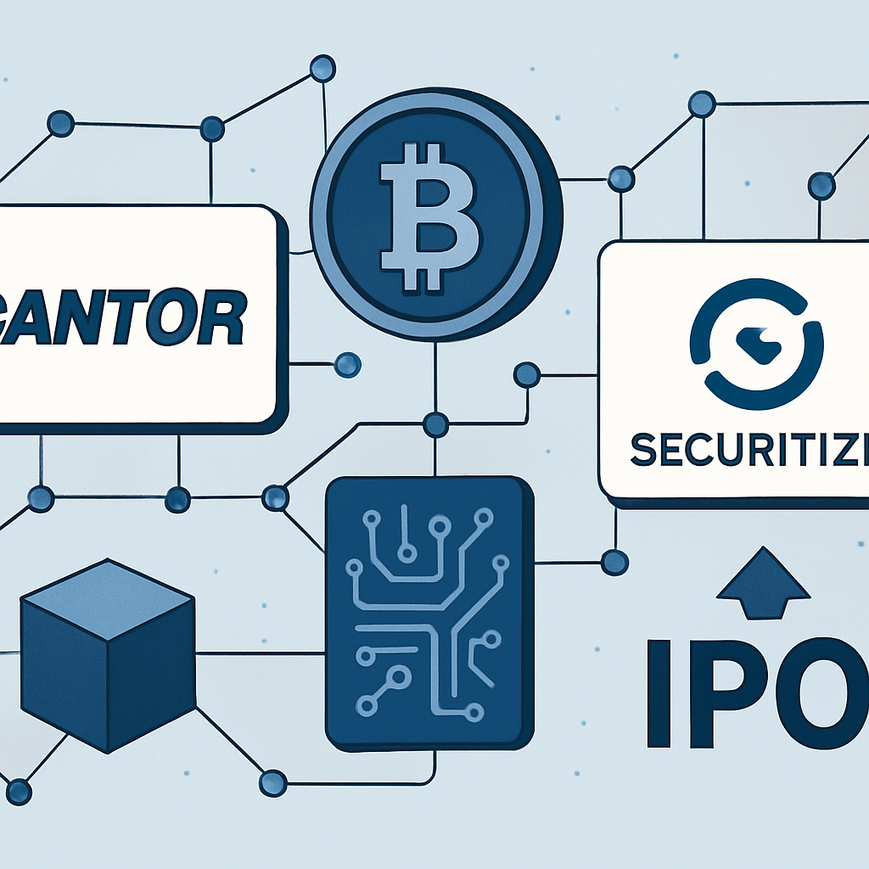
A new bridge for raising capital: what Cantor and Securitize announced
Joint infrastructure for tokenized IPOs
Cantor Fitzgerald and Securitize are partnering to build infrastructure that lets public companies raise capital onchain. The collaboration aims to support tokenized IPOs and onchain secondary equity offerings while operating inside the existing US securities framework. This is not a speculative experiment — it’s positioned as compliant tooling for regulated issuers, underpinned by Securitize’s tokenization stack and Cantor’s distribution and capital markets expertise.
Focus on secondary markets as well as primary issuance
Beyond initial offerings, the project explicitly targets secondary equity liquidity. That means companies could conduct follow-on offerings, block trades, and continuous trading of tokenized securities, potentially shortening settlement times and broadening the investor base for both institutions and retail participants.
How tokenized IPOs will work under current rules
Compliance-first architecture
A key selling point of the Cantor-Securitize push is compatibility with existing securities law. Tokenized IPOs will need to bake in investor accreditation checks, transfer restrictions, and reporting obligations at the protocol level. Securitize’s platform has previously wrapped compliance metadata into tokens; combining that with Cantor’s capital markets workflows aims to deliver offerings that meet SEC and FINRA expectations without undermining onchain efficiency.
Custody, settlement and clearing considerations
Tokenized securities change the plumbing for custody and settlement. Instead of DTCC-style reconciliation cycles, tokens can settle nearly instantly onchain, but they still require regulated custody, dispute resolution processes, and reconciliable records for auditors. Expect pilot programs to rely on qualified custodians and sandboxed environments — similar to other tests that have used regulated platforms to trial reduced settlement times.
Benefits for issuers and investors
Faster settlement and lower operational costs
Tokenized IPOs promise settlement compression and automation through smart contracts. Faster settlement reduces counterparty and operational risk, potentially lowering distributions and underwriting costs. For issuers, that could mean cheaper capital raising over time.
Expanded access and potentially deeper liquidity
Onchain issuance can open allocation and secondary access to a broader investor set, including fractional holdings and 24/7 markets. That could democratize participation in IPOs and improve price discovery for tokenized securities. If designed well, fractionalized tokenized securities can attract liquidity that traditional block trading sometimes leaves untapped.
Risks and real-world lessons to watch
Oracle, infrastructure and smart contract hazards
The Ostium incident — where falsified future-dated oracle data was used to manufacture fake trading profits and trigger an $18 million payout — is an object lesson. Any tokenized IPO stack will depend on external data, oracles, and bridging services. Robust oracle design, rigorous auditing, and multi-layered controls will be essential to prevent manipulation or unexpected payouts.
Regulatory, tax and market-structure hurdles
Even if offerings are launched inside existing frameworks, unresolved policy questions remain: How will broker-dealer rules adapt? Which post-trade safeguards are mandatory? How will tax treatment apply to token transfers vs. disposals? Lawmakers and regulators are actively debating market structure and stablecoin frameworks; tokenized IPOs will operate in that shifting regulatory landscape.
How this partnership fits the broader tokenization wave
Government pilots and industry momentum
The Cantor-Securitize collaboration arrives as governments and institutions explore tokenized assets. Central banks and finance ministries are piloting tokenized government bonds and digital securities in sandboxes. That creates a favorable environment for private-sector pilots that can interoperate with institutional tokenized markets later.
Competitive dynamics: incumbents vs. new entrants
Securitize brings tokenization technology and regulatory experience; Cantor brings placement and underwriting capabilities. Together they could pressure traditional issuance workflows and encourage other banks to build or partner for onchain issuance. This is also a space where stablecoin providers, custody platforms, and decentralized infra projects may compete to provide rails for settlement and liquidity.
Practical next steps for issuers and investors
What issuers should prepare now
Companies considering tokenized IPOs should audit their shareholder recordkeeping, assess custody options, and begin engaging legal counsel with experience in tokenized securities. They should also run small-scale tokenized secondary offerings in sandboxed environments to test investor onboarding and compliance flows.
What investors should ask before participating
Investors should request clarity on custody, transferability, compliance gates (KYC/AML), redemption mechanisms, and secondary market rules. Understand whether tokens represent direct equity, a regulated security token, or a synthetic exposure, and confirm how investor protections are enforced onchain.
Frequently Asked Questions
What exactly is a tokenized IPO?
A tokenized IPO issues equity as digital tokens on a blockchain rather than (or alongside) traditional certificated shares. These tokens embed compliance controls and can enable faster settlement and fractional ownership.
Will tokenized IPOs be legal in the US?
Tokenized IPOs can be legal if structured to comply with US securities laws. The Cantor-Securitize effort emphasizes working within the existing regulatory framework, using compliance metadata, registered intermediaries, and qualified custodians.
How do tokenized securities handle investor protections?
Investor protections are enforced via protocol-level transfer restrictions, compliance gates (KYC/AML), escrowed settlement logic, and the involvement of regulated intermediaries such as broker-dealers or custodians. The goal is to map existing legal obligations to onchain processes.