

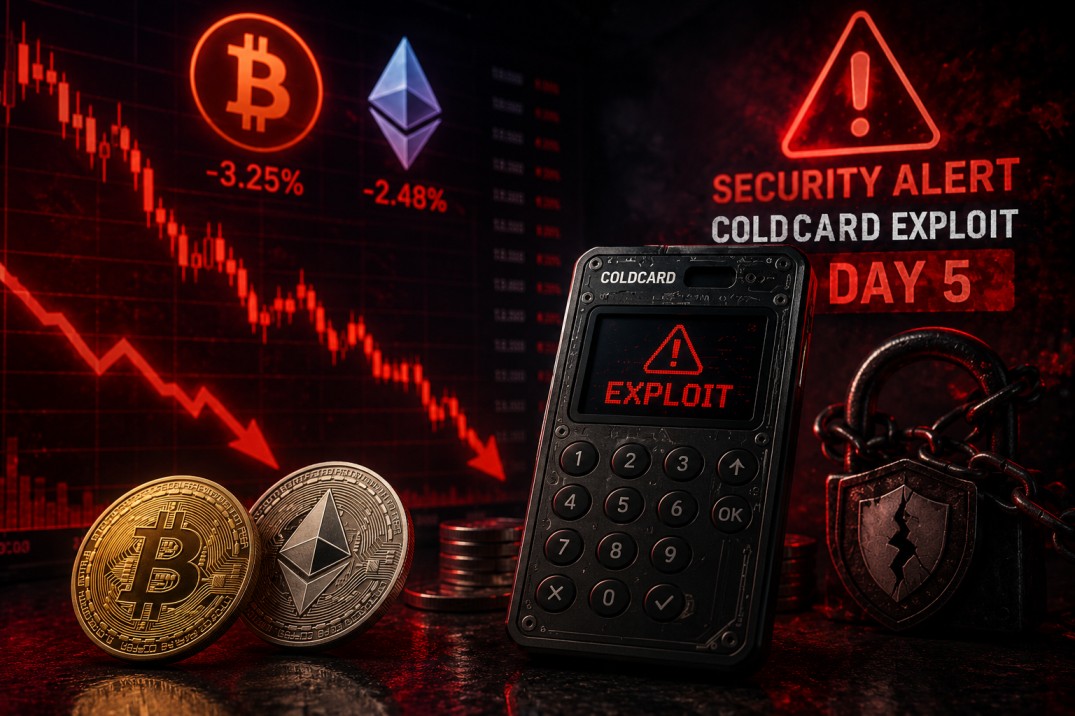
Bitcoin and ether started the week under pressure as the Coldcard exploit stretched into a fifth day, deepening anxiety around wallet security and draining confidence from a market already struggling for conviction. Even so, the sell-off has been relatively restrained compared with the scale of the reported losses, suggesting traders are reacting with caution rather than panic. That balance between contained price action and worsening sentiment is now shaping the near-term outlook for the broader crypto market.
Coldcard-linked thefts keep expanding as onchain losses mount
Researchers trace multiple waves of wallet sweeps
The most immediate catalyst behind the latest weakness is the ongoing Coldcard exploit, which researchers say has continued through several waves of thefts. Blockchain analysts identified a growing number of compromised addresses, with observed losses rising toward roughly $89 million as the attacker expanded from larger balances to smaller wallets. In one reported window alone, more than 1,000 BTC was drained across over a thousand addresses in less than an hour.
This pattern has made the Coldcard exploit especially damaging to sentiment. Rather than appearing as a single contained event, the thefts have unfolded in stages, keeping users and traders on edge as each new wave suggests the attack remains active.
Replace-by-fee creates a narrow escape window
One unusual aspect of the incident is that some pending transactions reportedly signaled replace-by-fee functionality. That means users who identify their addresses in the mempool may have a brief chance to outbid the attacker and move funds first. Analysts warned, however, that the window is extremely small and requires technical awareness plus rapid action.
The fact that a cold storage failure may still leave a slim rescue route has become one of the most closely watched details of the Coldcard exploit. But for many holders, the bigger takeaway is less about recovery and more about the uncomfortable reality that hardware wallets can still harbor long-lived vulnerabilities.
Bitcoin and ether fall, but forced selling still looks limited
Weak participation matters more than liquidation stress
Despite the severity of the wallet breach, bitcoin and ether have not collapsed in the way some might expect after such a major security event. Market participants say that is because the current weakness appears driven more by fading participation than by broad forced selling. ARP Digital’s Yusuf Fakhro pointed to negative ETF flows, lower CME open interest, and the absence of fresh purchases from Strategy as evidence that momentum has simply stalled.
That distinction is important for the crypto market outlook. If prices were falling because of widespread leverage liquidations, volatility might be more extreme. Instead, the market seems to be drifting lower as buyers step back and confidence erodes.
Bitcoin basis and ETF demand show fading enthusiasm
Another sign of a more mature but less energetic market is the collapse in bitcoin futures carry. Quarterly basis yields have lagged two-year U.S. Treasury yields since February, reducing the appeal of cash-and-carry arbitrage. At the same time, spot Bitcoin ETFs posted only modest net inflows in July and remain deeply negative on a year-to-date basis after heavy outflows in prior months.
These data points reinforce why the Coldcard exploit has hit such a vulnerable backdrop. Crypto was already dealing with thinning participation, weaker arbitrage incentives, and softer institutional demand. The wallet hack did not create those problems, but it intensified them at a moment when the market had little spare optimism.
Cold storage confidence takes a hit as users move funds to exchanges
Small bitcoin holders are reversing post-FTX behavior
One of the most revealing consequences of the incident is the way users are responding. Blockchain analytics firms have reported that smaller holders are moving funds from self-custody onto exchanges for perceived safety. That marks a notable reversal from the behavior seen after the FTX collapse in late 2022, when users rushed to withdraw coins from centralized platforms and embrace self-custody.
This shift shows how deeply the Coldcard exploit has shaken assumptions around cold storage. For years, hardware wallets were promoted as one of the safest options for long-term holders. Now, even if the issue is tied to a specific vulnerability rather than the concept of self-custody itself, some users are reconsidering where risk actually sits.
Diversification of custody becomes a bigger theme
The response from prominent industry figures has reflected that change. Binance founder Changpeng Zhao said hardware wallets can still contain bugs and suggested users spread funds across multiple wallets. That advice aligns with a growing view that security should rely less on any single device or custody model and more on layered risk management.
As the Coldcard exploit continues to unfold, diversification is emerging as the practical lesson. For retail holders and larger investors alike, the event may accelerate the trend toward splitting assets among hardware wallets, custodians, exchanges, and multisig setups rather than trusting one solution completely.
Macro signals are not offering bitcoin much relief
Falling oil and yields failed to spark a crypto bounce
Ordinarily, lower Treasury yields and easing inflation fears would provide at least some support for non-yielding risk assets. But even as oil prices and U.S. yields fell following renewed U.S.-Iran talks, bitcoin and ether failed to stage a convincing rebound. That divergence suggests crypto-specific headwinds are outweighing any macro relief.
The market also remains sensitive to rising real yields, which tend to pressure assets like bitcoin that do not generate income. Analysts have noted that current Treasury dynamics are weighing on crypto valuations more through real rates than inflation itself.
Key technical levels are back in focus
For longer-term investors, attention is shifting toward major support zones. Strategy is reportedly watching bitcoin’s 200-week moving average, a level the asset has historically respected during deeper drawdowns. Some analysts believe bitcoin could still carve out an August bear-market bottom, though that depends heavily on whether macro conditions worsen and whether the security shock from the Coldcard exploit fades.
In the short term, the lack of a relief rally is telling. Even with some supportive macro signals, crypto has struggled to attract buyers because trust and participation are still under pressure.
Regulation, exchange approvals, and market structure still matter in the background
FCA registration and Korean exchange plans add contrast
While the security story dominates headlines, other industry developments show that crypto infrastructure is still advancing. Robinhood’s U.K. arm was added to the Financial Conduct Authority’s list of registered cryptoasset companies at the end of July, marking a meaningful regulatory step for its expansion. In South Korea, Bithumb said it plans to seek a preliminary listing review in 2027, though it has not named a specific venue.
These developments matter because they highlight a split screen for the industry. On one side, the Coldcard exploit is undermining confidence in security practices. On the other, regulated access points and corporate ambitions continue to move forward, suggesting the sector is not standing still.
Senate timing adds uncertainty for U.S. market structure
In the United States, lawmakers are running out of time before the Senate’s August break to advance the Clarity Act. With only a short window left, uncertainty around market structure legislation remains another drag on sentiment. Traders are balancing immediate security concerns with the possibility that delayed regulation could prolong the ambiguity facing exchanges, issuers, and institutional participants.
That mix of security stress and unfinished policy work helps explain why the crypto market outlook remains fragile even beyond the wallet incident itself.
Why this episode could reshape crypto security expectations
Audits and open-source assumptions are under scrutiny
Reports around the incident suggest the underlying bug may have escaped detection for years because auditors confirmed the intended random number generator existed, but not that it was actually being called. If accurate, that detail raises difficult questions about audit depth, firmware review standards, and how open-source transparency is being interpreted in practice.
The Coldcard exploit therefore carries implications far beyond a single vendor. It could push the industry toward stricter verification methods, more adversarial testing, and a broader reassessment of how wallet security claims are validated.
A more mature market still faces old vulnerabilities
At the same time, the market response shows crypto is evolving. Prices have weakened, but not in full panic mode. Futures basis has compressed, leverage appears lower, and participants are somewhat less reactive than in earlier cycles. Yet the continuing thefts also prove that foundational security risks remain unresolved.
That contradiction defines the current moment. Crypto may be maturing in market structure, but events like the Coldcard exploit show the industry is still exposed to basic trust failures that can quickly hit adoption, custody preferences, and price sentiment all at once.
Frequently Asked Questions
Why are bitcoin and ether falling if the market reaction seems restrained?
Bitcoin and ether are slipping because confidence has weakened, not necessarily because of widespread forced selling. Negative ETF flows, lower futures activity, and the ongoing wallet security concerns have reduced buying interest.
What makes the Coldcard incident especially significant?
The Coldcard exploit is significant because it affects confidence in cold storage, which many investors consider one of the safest ways to hold crypto. The losses have also expanded in multiple waves, keeping the market nervous.
Are users really moving funds back to exchanges?
Yes. Onchain analysts report that some smaller holders are transferring bitcoin to exchanges for safety, which is the opposite of the self-custody trend that followed the FTX collapse.