


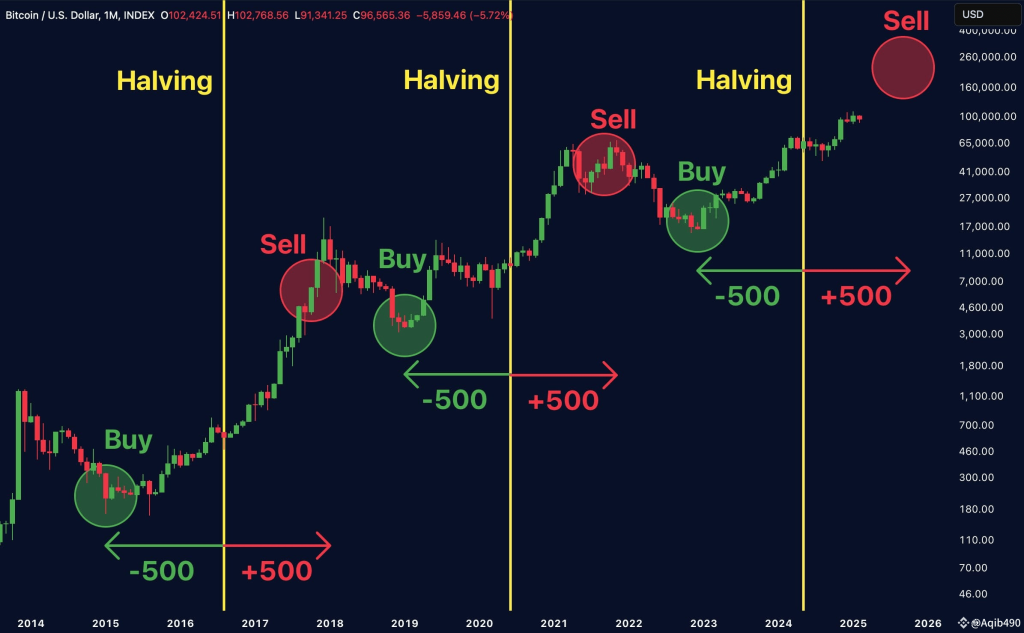
The 500-day rule has long been one of Bitcoin’s simplest cycle frameworks: buy roughly 500 days before a halving, then sell around 500 days after. In prior market eras, that timing would have captured a large portion of Bitcoin’s strongest upside. But in 2026, that once-clean historical pattern is facing a far more complex macro backdrop, and investors are questioning whether the rule still holds in a market increasingly shaped by institutions, ETFs, global liquidity, and shifting risk appetite.
Bitcoin has recently hovered near the mid-$60,000 range while sentiment remains fragile. On-chain data shows the market is in one of its coldest phases since the FTX collapse, even as some retail buyers and whales step in around major long-term support zones like the 200-week moving average. That tension is exactly why the current test matters so much: this cycle is no longer just about halving mechanics, but about whether macro and structural forces can overwhelm a historically reliable pattern.
Why the 500-day rule is under pressure in this Bitcoin cycle
A strategy built on past halving behavior
The 500-day rule gained popularity because Bitcoin’s prior halving cycles showed a recognizable rhythm. Scarcity tightened after each halving, supply issuance dropped, and price eventually followed. Traders who bought well before the event and sold well after it often outperformed more emotional market participants.
That historical success made the rule feel almost mechanical. Yet the current environment suggests Bitcoin may be moving beyond a purely halving-driven asset. Spot ETFs, sovereign policy debates, institutional treasury allocations, and derivatives liquidity have changed the market’s structure. The result is a cycle that may still rhyme with the past, but not repeat it exactly.
Why this cycle may not look like the last three
The biggest challenge to the 500-day rule is that Bitcoin now trades inside a much broader financial system. In earlier eras, internal crypto catalysts dominated. Today, Bitcoin reacts more visibly to bond yields, dollar strength, risk sentiment, geopolitical headlines, and central bank liquidity expectations.
That means a post-halving rally is no longer guaranteed to unfold on the same timetable. If macro tightening persists or capital rotates elsewhere, the halving’s supply shock may take longer to influence price. For investors relying on the 500-day rule, timing risk is becoming more significant than in prior cycles.
The macro storm around Bitcoin is getting louder
Arthur Hayes sees AI debt as the next Bitcoin catalyst
Arthur Hayes has argued that the debt-fueled AI infrastructure boom could become a major future catalyst for Bitcoin. His thesis is that excessive leverage tied to AI data-center expansion may eventually crack, forcing government intervention, bailouts, and renewed money printing. In that scenario, Bitcoin would likely benefit as investors seek assets insulated from fiat debasement.
This argument matters because it shifts attention away from the halving alone. If Hayes is right, the next major move in Bitcoin price cycle dynamics may come from a macro liquidity event rather than from block subsidy reductions. That would further complicate the simple timing assumptions embedded in the 500-day rule.
Global markets are not sending a clear risk signal
Recent market action has been mixed. World equity benchmarks have set fresh highs while Brent crude has softened on hopes tied to the Strait of Hormuz. Normally, such conditions might support broader risk assets, yet Bitcoin has not produced the kind of powerful upside many bulls expected after the halving.
This divergence suggests Bitcoin is still searching for its next dominant narrative. It is being pulled between safe-haven expectations, speculative tech correlations, and institutional portfolio flows. That uncertainty makes the current post-halving Bitcoin period one of the hardest to interpret in years.
A 14-year ratio has turned against the bulls
Long-term relative strength is showing a notable shift
One of the more concerning signals for Bitcoin bulls is that a 14-year ratio that had long moved in Bitcoin’s favor has now decisively turned the other way. While not every ratio reversal guarantees a prolonged downturn, this kind of structural change tends to get attention because it suggests an established edge may be fading.
For cycle watchers, this is especially important. The 500-day rule assumes Bitcoin’s broader long-term trajectory remains intact enough for historical timing to matter. But if key intermarket relationships are changing, then the assumptions underpinning older cycle models may need to be revised.
Sentiment remains cold despite support from buyers
Glassnode has confirmed that aggregate cycle tools are in their coldest phase since late 2022. At the same time, there are reports that both retail participants and whales have been accumulating near the 200-week moving average. This creates a split picture: conviction buyers are active, but broader market enthusiasm is still weak.
That leaves the Bitcoin halving cycle in a delicate position. On one hand, deep pessimism can create strong rebound conditions. On the other, weak sentiment can persist longer than bulls expect, especially when leveraged positioning and institutional flows remain cautious.
Institutions are reshaping how the market absorbs supply
ETFs and treasury activity matter more than ever
Institutional participation now plays an outsized role in market structure. Bitcoin ETF holdings have fluctuated significantly, and flows can quickly alter short-term momentum. Meanwhile, corporate treasury strategies continue to influence perception, especially when large entities buy or sell into weakness.
This is one reason the 500-day rule may face its biggest test yet. In previous cycles, retail participation and miner behavior carried more weight. Today, ETF rebalancing, portfolio hedging, and corporate capital management can disrupt the clean arc that many traders once expected from the Bitcoin halving cycle.
Support levels are stronger, but upside may be slower
The institutional era has likely improved Bitcoin’s long-term legitimacy, but it may also dampen the speed of explosive upside. A larger, deeper market often means more resistance, more hedging, and a more gradual repricing process.
That does not invalidate the bullish case. It simply means the post-halving Bitcoin rally could be more uneven, with periods of stagnation replacing the sharp vertical moves seen in earlier cycles. Investors using historical templates need to account for that possibility.
Why security shocks and market fear still matter
Cold wallet hacks are hitting confidence
Recent revelations around hardware wallet vulnerabilities and large-scale thefts have added another layer of caution to the market. Even though these incidents do not alter Bitcoin’s monetary policy, they can damage confidence among self-custody users and smaller investors.
Security shocks often arrive at the worst possible moment in fragile markets. If participants are already uncertain about the Bitcoin price cycle, wallet exploits and theft headlines can deepen fear and delay recovery in sentiment.
Extreme fear can be a warning or an opportunity
Despite these concerns, extreme fear has historically created some of Bitcoin’s better long-term entry conditions. That does not mean the bottom is guaranteed, but it does mean bearish consensus should be treated carefully. Contrarian setups often emerge when the market is least willing to believe in them.
For now, the key question is whether this fear marks a final shakeout within the 500-day rule window, or evidence that the old cycle model is breaking down. The answer will likely depend less on Bitcoin’s internal mechanics and more on global liquidity over the coming quarters.
The real lesson: Bitcoin’s cycle models are maturing
Historical rules still matter, but not in isolation
The 500-day rule remains useful as a framework because Bitcoin halvings still reduce new supply and still influence long-term scarcity narratives. But this cycle shows that no single rule should be treated as a complete strategy.
Investors now have to weigh halving effects against ETF flows, macro policy, liquidity conditions, institutional accumulation, and changing cross-asset relationships. The market has matured, and cycle analysis has to mature with it.
This may be the biggest test yet, not the end of the thesis
Calling this the biggest test for the 500-day rule does not mean the concept is dead. It means Bitcoin has entered a phase where historical pattern recognition must coexist with broader financial analysis. If liquidity expands and institutional demand strengthens, the rule could still look impressive in hindsight. If not, this cycle may become the one that proves timing models are no longer enough on their own.
For Bitcoin bulls, that is uncomfortable but necessary. The asset is no longer an isolated experiment. It is increasingly part of the global financial system, and that means its old rules must survive a much tougher arena.
Frequently Asked Questions
What is the 500-day rule in Bitcoin?
The 500-day rule is a cycle-based strategy suggesting investors buy Bitcoin about 500 days before a halving and sell around 500 days after it. It performed well in several previous halving cycles.
Why is the 500-day rule facing a bigger test now?
This cycle includes stronger institutional influence, ETF flows, macroeconomic uncertainty, and shifting risk sentiment. Those factors make Bitcoin less dependent on halving patterns alone than in the past.
Is Bitcoin still bullish after the halving?
Many analysts remain constructive on Bitcoin over the long term, but the current post-halving Bitcoin phase is more uncertain than prior cycles. Price action may depend more on liquidity, macro policy, and institutional demand than on historical timing models alone.