

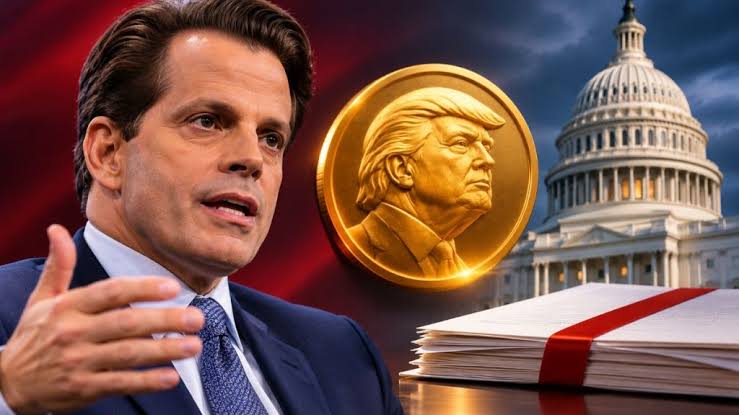
SkyBridge Capital founder Anthony Scaramucci has blamed US President Donald Trump’s cryptocurrency business interests and memecoin launches for undermining bipartisan support for the Digital Asset Market CLARITY Act. According to Scaramucci, Trump’s crypto ventures weakened Democratic lawmakers’ willingness to support broader cryptocurrency regulation, contributing to the legislation’s failure to advance in the Senate.
Speaking with Cointelegraph at SALT London, Scaramucci argued that the launch of Trump-linked memecoins shortly before his January 2025 inauguration disrupted the political momentum that had emerged following the 2024 presidential election.
When asked whether these activities were the primary reason the legislation failed to advance, Scaramucci described them as the “singular reason,” pointing to the loss of support among Democrats who had previously shown greater willingness to work with Republicans on crypto regulation.
However, he also acknowledged that disagreements over proposed ethics restrictions and the White House’s position contributed to the legislative breakdown.
Trump’s Memecoin Launches Complicated Bipartisan Crypto Support
Scaramucci believes the timing of Trump’s cryptocurrency ventures created a political obstacle for lawmakers seeking to establish a clearer regulatory framework for digital assets.
The Official Trump (TRUMP) memecoin launched on January 17, 2025, just three days before Trump’s inauguration. The launch, followed by broader activity involving Trump-associated crypto businesses, raised questions among Democratic lawmakers about potential conflicts of interest between presidential business activities and federal cryptocurrency policy.
According to Scaramucci, these developments changed the political environment and made it more difficult for Democrats to support legislation associated with the administration’s broader crypto agenda.
His comments highlight a wider challenge facing the US cryptocurrency industry: achieving bipartisan agreement on digital asset regulation while lawmakers remain divided over the financial interests of public officials.
CLARITY Act Fails to Advance in the Senate
The controversy comes after the US Senate failed to advance the CLARITY Act on September 15, 2026.
The procedural motion received fewer than the 60 votes required to proceed, leaving the legislation stalled despite months of negotiations between lawmakers.
The CLARITY Act was designed to establish a comprehensive federal regulatory framework for digital assets, including clearer responsibilities for the Securities and Exchange Commission (SEC) and Commodity Futures Trading Commission (CFTC).
The legislation was intended to reduce regulatory uncertainty surrounding digital asset markets and establish clearer rules for cryptocurrency companies operating in the United States.
Before the Senate vote, Republican lawmakers released a revised version of the legislation on September 14. According to Senator Cynthia Lummis, the updated draft incorporated 126 substantive changes requested by Democrats.
Despite these revisions, the bill failed to secure sufficient support to move forward.
The disagreement over government officials’ cryptocurrency investments and business interests remained one of the central obstacles to reaching an agreement.
Ethics Restrictions Become a Major Point of Disagreement
Beyond the memecoin launches, Scaramucci identified disagreements over ethics provisions as another important factor behind the legislative setback.
Some lawmakers wanted stronger restrictions designed to prevent government officials from benefiting financially from cryptocurrency activities while influencing the industry’s regulatory environment.
Scaramucci said lawmakers were attempting to introduce meaningful enforcement mechanisms into the ethics provisions, but the White House was unwilling to accept the proposed restrictions.
He argued that responsibility for the failed negotiations was shared by both sides.
The disagreement illustrates how the debate surrounding cryptocurrency regulation extends beyond technical questions about token classification, exchange oversight, and market structure. It also involves questions about transparency, financial interests, and potential conflicts of interest among policymakers.
Trump’s Crypto Business Interests Face Growing Scrutiny
Concerns about Trump’s cryptocurrency activities have extended beyond the CLARITY Act negotiations.
In July 2026, five Democratic senators called for hearings examining Trump’s crypto holdings and potential conflicts of interest. Their concerns centered on whether the president’s financial interests could influence decisions involving cryptocurrency regulation.
House Financial Services Committee Chair French Hill also acknowledged that Trump’s cryptocurrency businesses had complicated efforts to advance digital asset legislation.
Further attention came from consumer advocacy organization Public Citizen.
In an August 27, 2026 report, Public Citizen estimated that investors had accumulated at least $4.7 billion in largely unrealized losses across Trump’s cryptocurrency-related ventures.
The report examined several projects, including the Official Trump memecoin, World Liberty Financial’s WLFI governance token, Trump Digital Trading Cards, USD1 stablecoin, and Trump Media’s digital asset treasury.
Public Citizen attributed approximately $3.2 billion in investor losses to the TRUMP memecoin alone.
The organization also reported that Trump generated approximately $635 million in memecoin licensing fees in 2025, based on his financial disclosure.
These figures represent Public Citizen’s estimates rather than independently established final losses. Nevertheless, the report added to the broader debate over the relationship between Trump’s private cryptocurrency interests and public policy decisions.
Scaramucci Sees Potential Progress Through the SEC
Despite the CLARITY Act’s legislative setback, Scaramucci remains interested in the potential for regulatory progress through the Securities and Exchange Commission.
He suggested that the SEC’s approach under Chair Paul Atkins could help tokenization reach what he described as “escape velocity.”
Tokenization involves representing traditional financial assets, such as stocks, bonds, and real estate, as digital tokens on blockchain networks.
Scaramucci believes that if tokenization achieves sufficiently widespread adoption, it could become increasingly difficult for a future SEC administration to reverse or significantly slow the industry’s development.
However, he acknowledged that it remains uncertain whether adoption will reach that level before the next administration takes office.
The SEC’s regulatory approach could therefore play an increasingly important role in shaping the US digital asset industry while comprehensive legislation remains stalled.
What Happens Next for US Crypto Regulation?
The failure to advance the CLARITY Act leaves cryptocurrency companies and investors facing continued uncertainty over the future of US digital asset regulation.
The legislation’s supporters argue that a clearer federal framework is necessary to encourage innovation, improve market transparency, and provide businesses with more predictable compliance requirements.
However, disagreements over ethics restrictions and government officials’ financial interests continue to complicate bipartisan negotiations.
Scaramucci’s latest comments suggest that Trump’s cryptocurrency ventures have become an important part of the political debate surrounding the legislation.
For now, market participants will be watching for potential efforts to revive the CLARITY Act, changes in SEC regulatory policy, and further negotiations between Democrats and Republicans.
Whether lawmakers can reach an agreement on market structure rules while addressing concerns over conflicts of interest remains an important question for the future of the US cryptocurrency industry.
Disclaimer: This article is for informational purposes only and does not constitute financial or investment advice.