

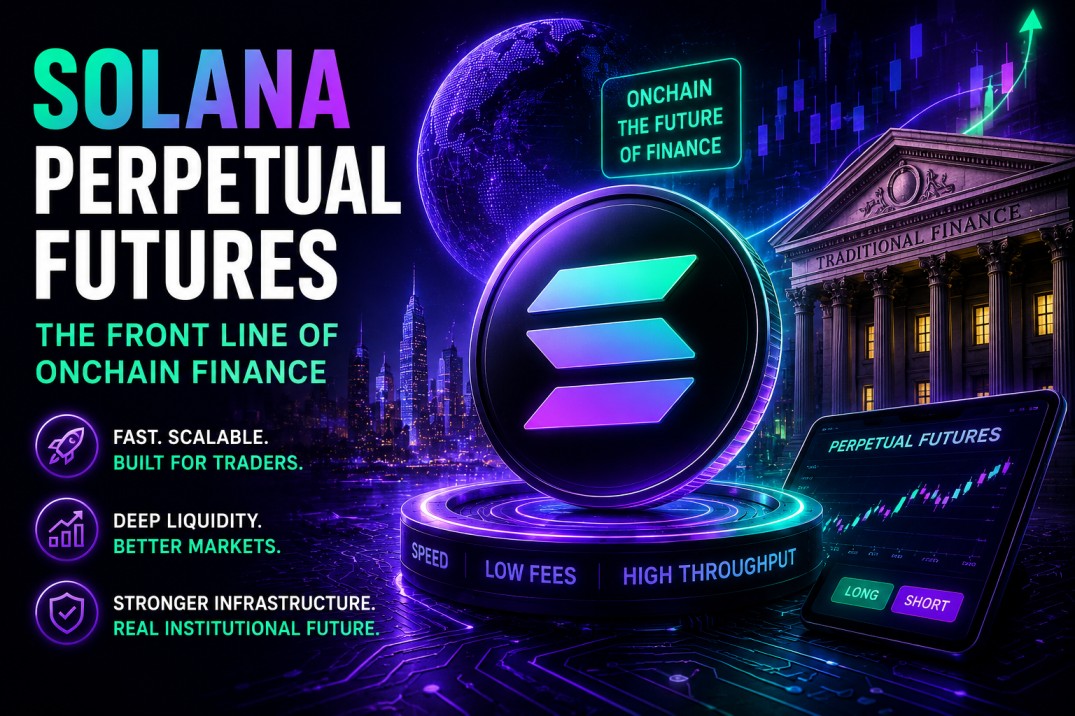
Solana is increasingly being framed as the critical battleground for the next phase of onchain finance, and the latest discussion around market structure makes that case clearer than ever. At the center of the debate is a simple idea: perpetual futures may be the product that finally pulls traditional finance onto blockchain rails at scale. If that thesis is right, then the Solana perpetual futures market is no niche sector. It is the front line in the competition to host the future of trading, liquidity, and tokenized financial assets.
Why perpetual futures are becoming crypto’s bridge to traditional finance
Perps are no longer seen as a crypto-only product
Brian Smith of the Jito Foundation argues that perpetual futures are a “trojan horse” for bringing traditional finance onchain. That framing matters because perps have historically been treated as a speculative corner of digital assets. Now, large market participants are increasingly discussing them as infrastructure.
The reason is simple: perpetual futures offer continuous price discovery, deep liquidity, and capital-efficient exposure without the rigid expiration dates of traditional futures. For institutions used to fast-moving, always-on markets, this model is attractive. As firms explore tokenized assets, onchain derivatives, and programmable market infrastructure, the venue that best supports perps could gain a major strategic advantage.
That is where the Solana perpetual futures narrative becomes especially important. Solana’s speed, low fees, and growing trading ecosystem make it one of the few chains that can realistically compete for serious institutional derivatives flow.
Traditional firms are warming to the structure
This shift is not just coming from crypto-native circles. DRW CEO Don Wilson recently argued that perpetual futures are not inherently reckless gambling tools and that regulators and traditional markets should start treating them more seriously. That kind of endorsement signals a broader change in tone.
At the same time, platforms are building specifically for this convergence. Ondo’s new network is powering a recently launched perpetual futures platform and is expected to expand into broader onchain financial asset trading. If tokenized securities and onchain derivatives begin to share the same rails, the chain that captures derivatives liquidity could become the natural home for much more of finance.
Solana’s performance edge makes this a high-stakes contest
Speed and cost still matter most in onchain trading
For onchain trading to compete with centralized exchanges and traditional market venues, execution quality matters more than branding. Traders want low latency, tight spreads, and enough throughput to support volatile periods without pricing distortions. Solana has built much of its reputation on exactly those strengths.
That is why the fight for Solana perpetual futures is about more than user numbers. It is about proving that decentralized markets can handle professional-grade order flow. If Solana can become the preferred environment for high-frequency and institutional-style derivatives activity, it would strengthen the chain’s position far beyond DeFi.
Shared liquidity is becoming a competitive weapon
Another reason Solana has momentum is the move toward more efficient liquidity design. Hyperliquid, for example, has been emphasizing shared liquidity instead of fragmented pools, giving firms the ability to compose with a common order book. Elsewhere, new models allow liquidity providers to keep assets in their own wallets while using one balance to support multiple positions.
This is exactly the kind of infrastructure traditional firms understand. Capital efficiency is a decisive factor in market adoption. A thriving Solana perpetual futures ecosystem could benefit if developers and exchanges continue reducing collateral friction, improving execution, and making liquidity more portable across protocols.
Market stress shows both the opportunity and the risks
Flash crashes reveal the importance of oracle design
Recent volatility in perpetual markets shows why this sector is so crucial and so fragile. A single pre-market trade in Korea reportedly sent a mark price down nearly 19%, triggering a fast and dramatic move before the market rebounded. The venue involved said its oracle functioned exactly as designed, even as the incident sparked concern across the industry.
This type of event highlights a key truth: if perps are going to onboard traditional finance, they must be resilient under abnormal conditions. Institutions may accept volatility, but they will not tolerate poorly understood price mechanisms or preventable liquidation cascades.
For Solana, this creates both risk and opportunity. If Solana perpetual futures platforms can demonstrate robust oracle systems, transparent risk controls, and reliable recovery from dislocations, they can turn market stress into proof of maturity.
Quiet trading volumes make quality even more important
Across major centralized exchanges, trading volumes recently fell to their weakest stretch in more than two years. That softer environment means every venue is competing harder for active flow. In a lower-volume market, traders become more selective about where they deploy capital.
This can actually favor platforms with better infrastructure. Instead of relying on broad speculative mania, exchanges and protocols must win on execution, trust, and product depth. Solana’s challenge is to convert technical advantages into sustained trading loyalty before rivals do the same.
Macro uncertainty is raising the stakes for onchain derivatives
Fed risk is pushing traders toward flexible instruments
Markets headed into the latest Federal Reserve decision with most participants pricing a hold, but a meaningful minority saw the risk of a surprise hike. Citadel Securities and UBS were among those warning that policy uncertainty had not fully disappeared. In this kind of environment, traders want flexible instruments that can react instantly.
That dynamic naturally benefits perpetual futures. Unlike many traditional products, perps offer continuous access and rapid repricing. As macro headlines move Bitcoin, Ether, and risk assets more broadly, onchain derivatives become more useful, not less.
The result is that Solana perpetual futures are not just competing with other crypto products. They are competing to become the preferred way to express macro-sensitive digital asset views in real time.
Bitcoin weakness and ETF outflows add pressure
Bitcoin has faced renewed selling pressure, and US spot Bitcoin ETFs recently recorded several straight sessions of outflows. Broader market stress from Asia equities and rate fears has also weighed on sentiment. When spot markets become uncertain, derivatives often gain relative importance because they allow hedging, leverage, and short exposure.
That backdrop strengthens the strategic case for Solana. If the next cycle is driven less by simple spot buying and more by active positioning across multiple assets, the chain that handles derivatives best may capture the most durable value.
Regulation and institutional infrastructure are moving closer to crypto rails
Canada, Europe, and Asia are setting the tone
Coinbase Canada’s leadership has called for permanent rules rather than temporary exemptions as the company expands toward derivatives, tokenized assets, and DeFi. In Europe, RL1 has launched as a member-owned blockchain cooperative backed by major financial institutions. In Asia, regulators are working on digital asset frameworks covering exchanges, custody, and stablecoins.
These developments matter because institutions do not only need good technology. They need legal clarity, operational standards, and confidence that new products will survive regulatory review. The Solana perpetual futures market stands to benefit if compliance-ready infrastructure matures alongside trading technology.
Tokenized assets could expand the addressable market
A major theme in recent announcements is that derivatives are no longer being built in isolation. The same infrastructure is increasingly expected to support tokenized securities, stablecoin settlement, and broader onchain market activity. Visa, PayPal, and other major payment and finance players are also signaling deeper interest in stablecoin and tokenized asset rails.
If that trend continues, the chain that wins in perps may also gain a head start in tokenized stocks, bonds, funds, and other financial products. That is why Solana’s current battle is so significant. Winning derivatives liquidity today could translate into owning a much larger slice of tomorrow’s onchain capital markets.
Solana must prove it can be the institutional home for onchain markets
The battle is about credibility, not just throughput
The headline argument that Solana must win this fight is ultimately about credibility. Throughput and low fees helped Solana stand out, but institutional adoption depends on a broader checklist: market integrity, risk controls, composable liquidity, dependable oracles, and enough depth to absorb shocks.
The next stage of competition will be less about theoretical performance and more about whether serious traders can trust the system with meaningful size. That is the standard the Solana perpetual futures ecosystem now has to meet.
Why this moment could define Solana’s next cycle
Crypto markets are entering a more demanding phase. Easy narratives are fading, volumes are thinner, macro risk is back, and institutions want products that resemble professional financial infrastructure. Perpetual futures sit right at the intersection of those trends.
If Solana can dominate this category, it may establish itself as the default execution layer for a broad range of onchain finance. If it fails, the opportunity could migrate to rival chains or specialized trading networks that better meet institutional needs. That is why this is not just another DeFi story. It is a strategic contest over where the future of digital markets will live.