

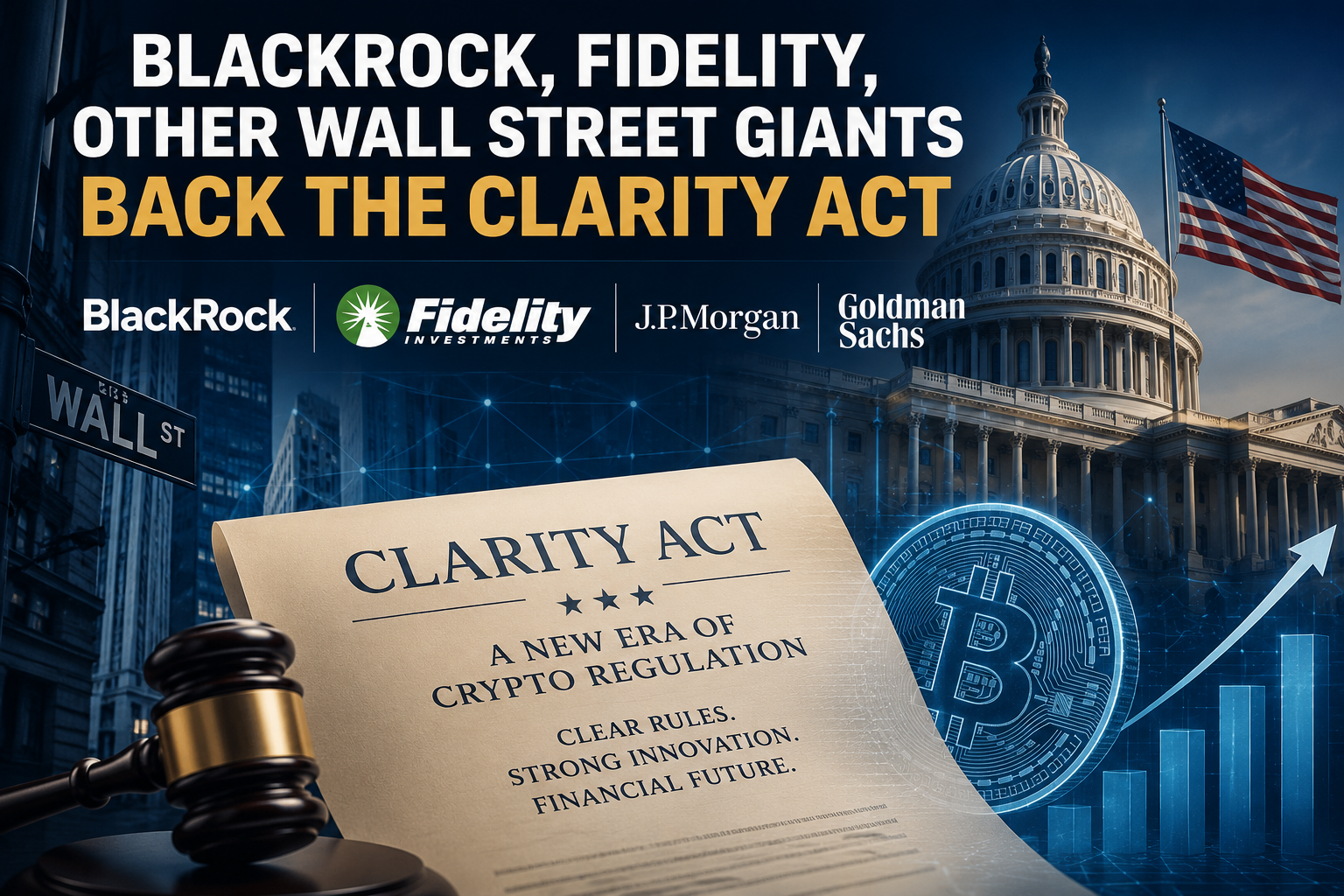
Wall Street’s biggest financial names are making their position on U.S. crypto regulation increasingly clear. BlackRock, Fidelity, Franklin Templeton, Goldman Sachs, and SoFi have all signaled support for the Clarity Act, a market structure bill that many in the industry see as a crucial step toward defining how digital assets should be regulated in the United States.
That support matters far beyond politics. It reflects a broader shift in which traditional finance is no longer watching crypto from the sidelines. Instead, major asset managers, banks, and fintech firms are actively pushing for rules that can support institutional participation, tokenized products, and more predictable oversight. Even as the Senate’s timeline tightens and the bill faces procedural uncertainty, the message from Wall Street is unmistakable: large financial institutions want a workable framework for digital assets, and they want it soon.
Why Wall Street Is Rallying Behind the Clarity Act
The growing coalition behind the Clarity Act shows how much the regulatory conversation has evolved. For years, large institutions approached crypto cautiously, often citing legal ambiguity as the biggest barrier to deeper involvement. Now that firms like BlackRock and Fidelity have built meaningful digital asset businesses, they have more reason to press for formal market structure legislation.
Institutional demand for clear digital asset rules
Asset managers and banks want to know how tokens are classified, which regulators have jurisdiction, and what standards apply to custody, trading, and disclosures. Without that clarity, expansion into crypto products remains expensive and legally risky. Backing the Clarity Act is therefore not just a policy stance; it is a commercial necessity for firms that already offer bitcoin ETFs, tokenization services, and digital asset exposure.
A sign that crypto is entering mainstream finance
Support from Goldman Sachs, Franklin Templeton, and SoFi underscores that crypto regulation is no longer a niche issue. It now affects core parts of the financial system, from exchange-traded products to settlement infrastructure. The more traditional institutions build around blockchain-based finance, the more pressure they put on lawmakers to provide rules that can scale with market demand.
Senate Delays Put the Crypto Market Structure Bill Under Pressure
Despite this wave of support, the crypto market structure bill faces a difficult path in Washington. Senate Majority Leader John Thune has indicated the measure is unlikely to clear the chamber before the August recess, while partisan disagreements over ethics language and consumer protections continue to slow momentum.
Political friction is clouding the bill’s near-term outlook
Even with backing from influential financial firms, legislation of this scale is vulnerable to broader political disputes. Democrats have raised concerns about ethics provisions, while state-level regulators such as New York Attorney General Letitia James have warned that a federal framework could weaken local enforcement powers. That tension has made the crypto market structure bill more complicated than a straightforward industry-backed reform package.
Markets are reacting, but not collapsing
Bitcoin slipped as the Senate shelved action and broader macro pressure hit risk assets, yet the market reaction has been relatively measured. Analysts have noted that traders may already have priced in a legislative delay. That muted response suggests investors still believe some form of digital asset framework eventually arrives, even if the Clarity Act misses the immediate timetable.
BlackRock and Fidelity See Regulation as a Growth Catalyst
For firms like BlackRock and Fidelity, support for the Clarity Act is closely tied to business expansion. These companies are no longer simply evaluating crypto exposure for clients; they are building products, distribution channels, and long-term strategies around digital assets.
ETF growth is changing institutional incentives
Spot bitcoin ETFs opened the door to broader participation, and the market is now seeing continued product development tied to Ethereum and Solana. One asset manager is already offering low-cost ETH and SOL exchange-traded products after its bitcoin fund surpassed $381 million in assets. This momentum strengthens the case for standardized regulation, because firms want confidence that product innovation will not be disrupted by shifting agency interpretations.
A compliant framework supports tokenization and custody
The institutional push also extends beyond ETFs. Firms are increasingly exploring tokenized securities, stablecoin infrastructure, and blockchain-based settlement. Companies like Securitize are expanding regulated services for tokenized assets, while Circle is deepening its banking and payment ambitions through a large patent acquisition from IBM. In this environment, the Clarity Act is viewed as foundational to the next phase of crypto finance rather than merely a fix for existing confusion.
Banks, Platforms, and New Rules Are Reshaping Crypto Infrastructure
The urgency around U.S. legislation is part of a larger global trend. Across markets, regulators and infrastructure providers are imposing stricter requirements while institutions build systems designed for compliance, privacy, and capital efficiency.
Privacy and institutional-grade rails are becoming priorities
EthSystems, which recently spun out of the Ethereum Foundation, is focused on privacy infrastructure for banks and financial institutions. That is a notable development because it shows the next phase of blockchain adoption is increasingly tailored to enterprise needs rather than retail experimentation alone. Institutional users want privacy, auditability, and interoperability built into the stack.
Capital and licensing demands are getting tougher worldwide
Elsewhere, the Bank of Russia has proposed draft rules requiring digital asset platforms to hold as much as $2.8 million in liquid capital, while also outlining broader trading and depository requirements. In Asia, regulators are tightening expectations around licensing and compliance, and Binance continues to face scrutiny across several jurisdictions. These examples reinforce why U.S. firms are backing the Clarity Act: if America does not create a coherent framework, institutions may be forced to navigate a patchwork of fragmented rules at home and abroad.
Market Structure Is Evolving Beyond Legislation Alone
Even as lawmakers debate rules, the industry itself is changing rapidly. New trading models, shared liquidity systems, and self-custodial infrastructure are redefining how crypto markets operate. That makes legislation more important, because regulators are not simply catching up to old exchange models; they are trying to oversee a moving target.
Shared liquidity and self-custody are changing market design
Hyperliquid is expanding access to a shared liquidity model that lets firms compose with one deep order book instead of splitting activity across fragmented pools. Similarly, 1inch has launched Aqua across 13 EVM chains, allowing users to provide liquidity across multiple protocols from a self-custodial setup. These changes challenge traditional assumptions about where trading occurs, who controls assets, and how liquidity should be supervised under a future digital asset regulation regime.
Security failures still show why regulation matters
At the same time, the market remains vulnerable to scams, weak compliance, and operational failures. Apple is facing a lawsuit over alleged fake bitcoin wallet apps that reportedly led to losses exceeding $1.8 million. Binance’s compliance adjustments have reportedly made law enforcement requests more difficult in some cases. Malware threats targeting wallet recovery phrases continue to spread through app stores. These episodes strengthen the case for digital asset regulation that protects users without smothering innovation.
The Clarity Act Could Define the Next Phase of U.S. Crypto Finance
The immediate future of the Clarity Act remains uncertain, but its significance is becoming harder to ignore. The bill sits at the intersection of Wall Street adoption, crypto market maturation, and the political struggle over how digital assets should fit into the U.S. financial system.
Institutional backing gives the bill long-term momentum
Even if the Senate delays action, endorsements from BlackRock, Fidelity, Franklin Templeton, Goldman Sachs, and SoFi create lasting pressure for progress. These firms represent capital, distribution, and credibility. When they align behind the same legislative framework, lawmakers have a harder time dismissing crypto as a marginal sector.
The bigger issue is whether the U.S. can lead
The real question is not only whether the Clarity Act passes before recess. It is whether the United States can establish a durable regulatory framework before other jurisdictions pull further ahead in tokenization, stablecoins, and blockchain-based finance. If Wall Street sees digital assets as part of future market infrastructure, Washington’s delay may eventually become the bigger risk.
Frequently Asked Questions
Why are BlackRock and Fidelity supporting the Clarity Act?
They want clear rules for token classification, trading, custody, and product issuance. Regulatory certainty helps large firms expand crypto offerings with lower legal and compliance risk.
Has the Clarity Act already passed the Senate?
No. The bill has gained major institutional backing, but Senate timing has tightened and lawmakers are unlikely to move it before the August recess.
Why does the crypto market structure bill matter to investors?
A formal framework could improve investor protections, reduce regulatory confusion, and support broader institutional participation in crypto products, tokenization, and trading infrastructure.