

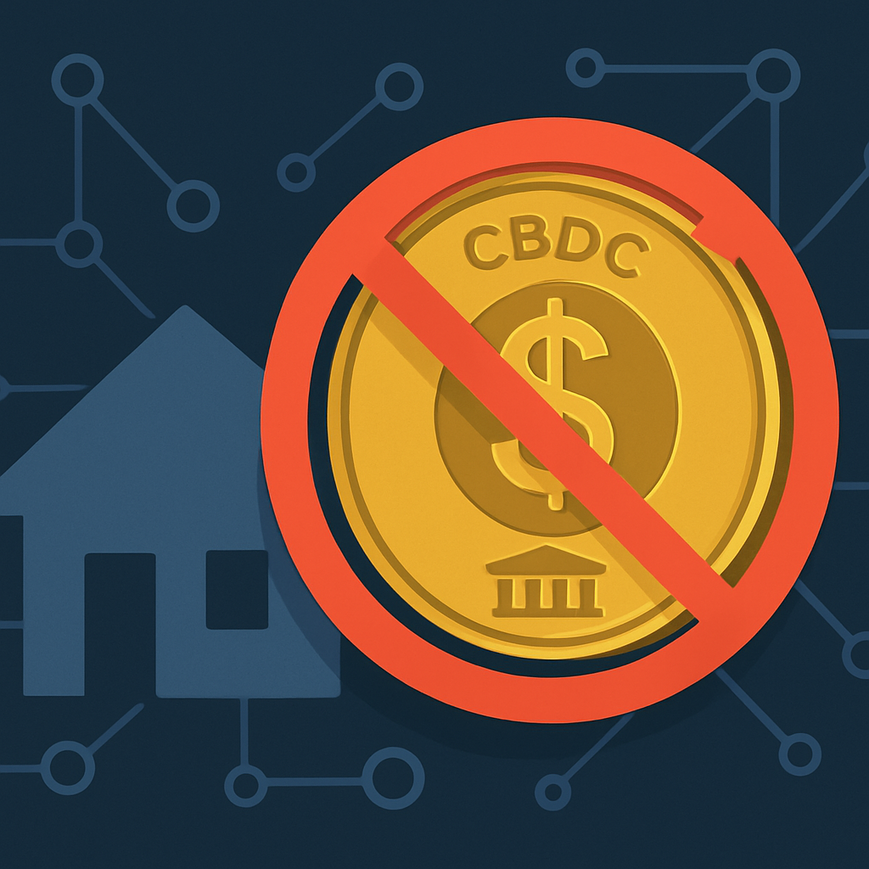
Midnight move: housing bill activates a CBDC ban
How the moratorium became law overnight
Despite President Donald Trump declining to sign Congress’ bipartisan housing bill, the measure is set to take effect at midnight unless a veto is issued and sustained. A key provision creates a temporary CBDC ban that prevents the Federal Reserve from developing a U.S. central bank digital currency until 2031. The enactment is procedural — the bill’s passage and absence of a veto deadline mean the moratorium becomes law at the stroke of midnight.
Immediate legal and administrative consequences
The new rule is narrowly tailored: it does not criminalize research or private tokenization experiments, but it does bar the Fed from launching or piloting a sovereign CBDC design. For policymakers and industry stakeholders, the CBDC ban creates a clear near-term constraint on any federal digital dollar timetable and redirects debate into regulatory channels and congressional amendments.
What the CBDC ban means for the Federal Reserve and the digital dollar
Fed authority curtailed, but research can continue
The moratorium constrains operational development and issuance, halting any formal Fed-led CBDC program until 2031. However, academic study, interagency coordination, and private-sector research into digital money architectures can continue. That distinction leaves the phrase digital dollar alive in conversation but legally off-limits as an issuance project.
Political tradeoffs behind the decision
Lawmakers framed the CBDC ban as a protection of privacy, monetary sovereignty and state banking prerogatives. But the move also signals congressional caution amid rising partisan scrutiny — and it hands a policy win to constituencies skeptical of central-bank-issued retail money while putting pressure on regulators to accelerate non-sovereign alternatives.
Stablecoins, bank charters and the regulated rails emerging
Circle, OCC approvals and the pivot to regulated infrastructure
The housing bill’s CBDC ban accelerates interest in regulated stablecoins and bank-centered custody as practical alternatives. Circle’s final OCC approval to form a national trust bank is emblematic: firms are seeking federal charters and custody frameworks to make stablecoins a safer, bank-regulated bridge for cross-border payments and settlement. Expect more charter applications as companies aim to fill the operational gap left by the CBDC ban.
How stablecoin regulation will adapt
With the Fed sidelined, Congress and banking regulators are likely to deepen focus on stablecoin regulation. The market is already evolving: stablecoin issuers are pursuing clearer compliance paths and custody models to reassure banks, exchanges and institutional clients. The trend suggests a future where stablecoin regulation and banking oversight determine how tokenized money flows internationally.
Market reaction: crypto prices, flows and volatility this week
Bitcoin retests resistance amid policy headlines
Markets absorbed the news without a wholesale sell-off. Bitcoin retested $64,400, and technical narratives point to a path toward the June high near $67,250 if momentum holds. Bitcoin’s consolidation (307 days in the $60k–$70k band) underscores how macro shocks and regulation headlines can roil sentiment without collapsing the market.
Fund flows and trader behavior
Institutional flows were mixed: spot bitcoin funds reported roughly $95 million in outflows and ether funds about $52 million on one session, erasing a recent institutional bright spot. At the same time, whale activity on Coinbase pushed the Coinbase Premium above key trend lines, fueling price resilience. Traders also watched XRP clear a range on late-session volume, testing $1.10 as potential support. These moves show how regulatory pivots like the CBDC ban intersect with liquidity, arbitrage and on-chain credit usage.
Broader ecosystem implications: prediction markets, tokenized credit and cross-border money
Prediction markets and product innovation
The policy shift may also influence novel derivatives and platforms. Polymarket’s push to allow under-collateralized positions — following Kalshi’s earlier margin approval — highlights the sector’s race to innovate within regulatory guardrails. State-level tax and oversight decisions will determine which products scale and where.
Tokenized credit and cross-border applications
Companies are exploring tokenized credit products and Bitcoin-backed loans in Japan and elsewhere, with projects involving JPYC, Progmat and Metaplanet. The temporary CBDC ban gives private stablecoins and tokenized credit markets an opening to provide efficient 24/7 rails for international corporate treasury needs, speeding cross-border liquidity without waiting for a sovereign digital dollar.
Policy outlook: next steps for Congress, regulators and industry lobbying
Legislative pathways and the CLARITY/Genius debates
The moratorium is time-limited. Bills like the CLARITY Act and the GENIUS Act remain active and could reshape the framework before 2031. Insiders suggest a new crypto market-structure draft may reappear for late-July action; however, bipartisan consensus remains elusive. That means incremental rulemaking at the SEC, OCC, and CFTC will play an outsized role in the near term.
Industry strategy in a post-CBDC-ban world
With the Fed constrained, industry players are doubling down on bank charters, custody standards, and compliance investments to entrench tokenized assets in regulated finance. Expect more lobbying aimed at clarifying stablecoin regulation, carving out safe harbors for wallets and developers, and defining how tokenized securities and payments will interplay with existing financial plumbing.
Frequently Asked Questions
What exactly does the CBDC ban prohibit?
The moratorium prevents the Federal Reserve from issuing, piloting or otherwise operating a sovereign retail CBDC until the specified sunset year (2031). It does not criminalize research or private-sector stablecoin development.
Does the CBDC ban stop private digital dollar projects?
No. Private stablecoins, tokenized dollars and bank-issued digital deposits can continue to be developed, subject to banking rules and stablecoin regulation. Many firms are pursuing federal charters and OCC approvals to operate within a regulated framework.
How will the CBDC ban affect cross-border payments?
Short term, the ban increases demand for regulated stablecoins and tokenized credit solutions to move money across borders. Firms exploring tokenized credit or bank-backed stablecoins may gain market share as corporates seek 24/7 settlement without a sovereign digital dollar.